
 Australia site →
 Global tax-deductible giving →
Cost-effectiveness
New Incentives posts quarterly updates on their cost per infant here. Future costs are estimated to be $20/infant as the program continues to expand.
New Incentives educates caregivers about the importance of vaccinating children and disburses cash incentives that are conditional on infants receiving four life-saving vaccines, provided through government clinics free of charge. New Incentives also works with government partners to improve vaccine supply.
Their annual demonstrated impact includes:
Donations are tax-deductible in the country selected. See our global tax-deductibility options.
By Card, Bank Transfer or Paypal
By Check, ACH, Zelle, Crypto, etc.
Childhood vaccines prevent an estimated 4-5 million deaths every year [1]. They are recognized as one of the most cost-effective child health interventions in low-income countries. Yet, in 2022, an estimated 14.3 million infants around the world didn’t receive a single dose of diphtheria-, tetanus-, or pertussis-containing (DTP) vaccines[2]. The problem of low immunization rates is especially clear and pressing in Nigeria. Nigeria is home to just 2.7% of the world’s population [3], yet it accounts for 18% of the world’s mortality of children under five [4]. Nigeria has some of the highest under-five mortality rates [5] and lowest vaccination coverage in the world. Around one-quarter of infants in northern Nigeria get fully immunized, leaving a large population of infants vulnerable to disease outbreaks[6].
The problem of low vaccination coverage in Nigeria is further exacerbated by extreme poverty. This is especially true in northern Nigeria, where many mothers live on less than $2 a day and cannot visit the clinic for various reasons. They face challenges such as affording the transportation cost to the clinic, associated loss in earnings from small-scale trading or farming, receiving permission from their partners, fear of vaccination side effects, cultural barriers to vaccination, or often a combination of these factors [7].
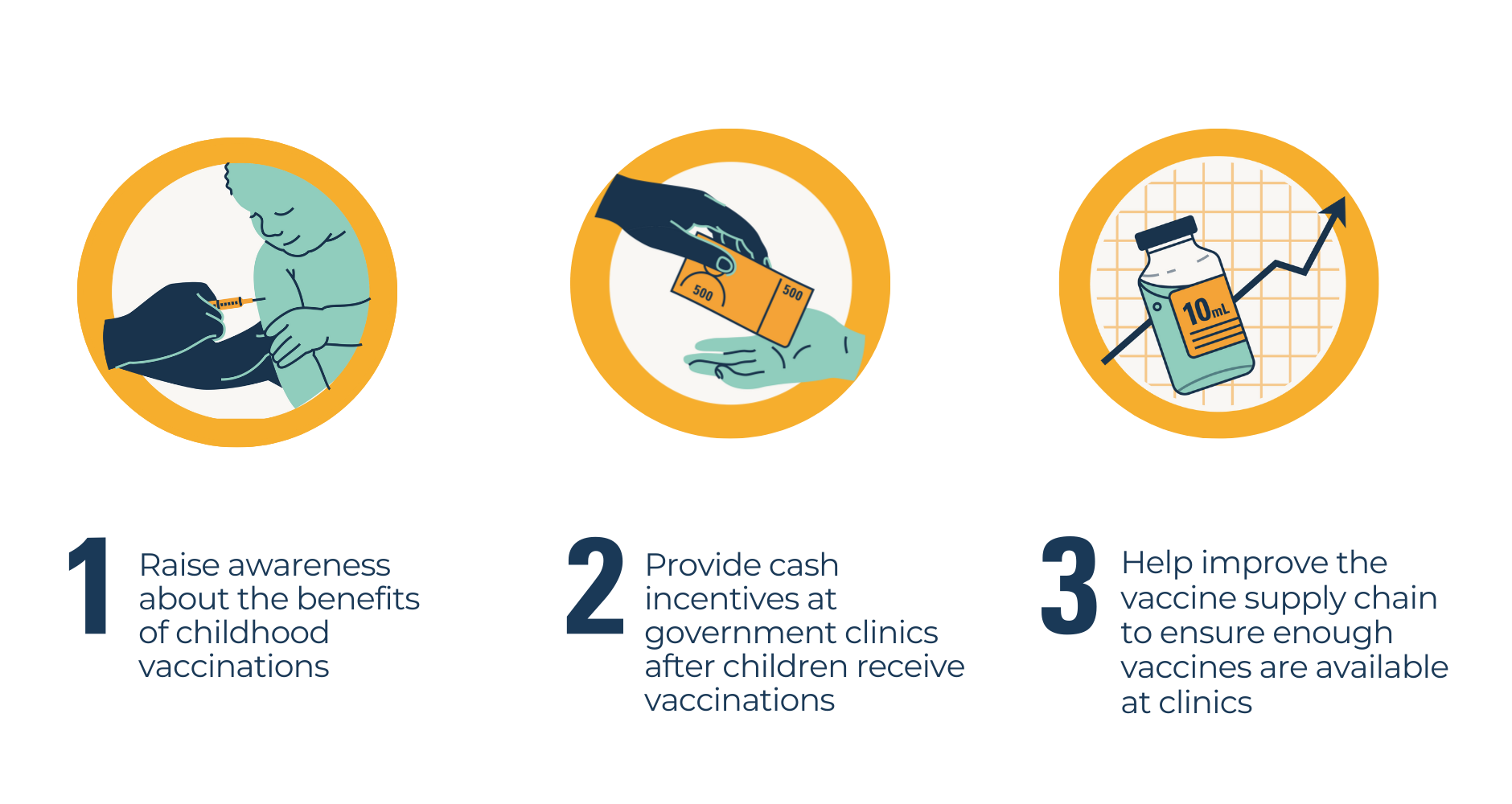
New Incentives increases vaccination rates by raising awareness about the benefits of childhood vaccinations, providing cash incentives at government clinics after children receive vaccinations, and helping improve the vaccine supply chain to ensure enough vaccines are available at the clinics.
Cash incentives of N1,000 (~$1.30) are disbursed at six different routine immunization visits, totaling N6,000 (~$8) over the first 15 months of an infant’s life.
A randomized controlled trial found that their program led to:
We recommend that gifts up to $1,000 be made online by credit card. If you are giving more than $1,000, please consider one of these alternatives.
What can you help New Incentives achieve? Enter a donation amount below to find out.
New Incentives posts quarterly updates on their cost per infant here. Future costs are estimated to be $20/infant as the program continues to expand.
New Incentives focuses on an intervention with very strong evidence of effectiveness and cost–effectiveness. The organization is transparent and has rigorous processes in place to monitor and ensure that its conditional cash transfers reach the intended recipients.
[1] World Health Organization, Immunization
[2] World Health Organization, Childhood immunization begins recovery after COVID-19 backslide
[3] World Bank, Data Bank: Nigeria
[4] World Health Organization, Breaking barriers, building bridges: the collaborative effort to reach every child in Nigeria
[5] UNICEF, Country profiles: Nigeria
[6] 2018 Nigeria Demographic and Health Survey
[8] IDinsight, Impact of Conditional Cash Transfers on Routine Childhood Immunizations: Evidence from North West Nigeria
All photos and videos courtesy of New Incentives.
Support New Incentives