

Sanku – Project Healthy Children

Sanku – Project Healthy Children’s mission is to provide children everywhere with the simple, inexpensive, basic nutritional support they require to survive and thrive. Sanku – Project Healthy Children focuses on achieving wide micronutrient coverage for at risk communities in Africa. 

Recent achievements include: Sanku’s nutrient premix factory in Dar es Salaam, Tanzania — the first of its kind in East and Central Africa — is now fully operational. The factory played a critical role in maintaining uninterrupted fortification supply during regional import disruptions in early 2026, demonstrating the resilience benefits of local production. Also in early 2026, Sanku’s flour bag factory at the same site produced a record 3.1 million flour bags bundled with premix, helping millers reduce costs while keeping fortified flour affordable for families.

Building on this model, Sanku has also broken ground on a second nutrient premix factory in Addis Ababa, Ethiopia, expected to localise premix production for Ethiopia and much of the surrounding region.

Key Strengths: Scale, Durability

Multidimensional Poverty Index Indicators: Nutrition

Other Key Outcomes: Child development 

Recent Expense Budget: US$11.3 million (FY26)

Year Founded: 2013


73 MILLION
Number of people that Sanku reaches with nutritious food everyday
1740
Number of flour millers partnering with Sanku in East Africa
1608
Number of installed Dosifier machines
$0.09
Sanku annual cost per person as of March 2026

Other ways to donate

We recommend that gifts up to $1,000 be made online by credit card. If you are giving more than $1,000, please consider one of these alternatives.

Check Bank Transfer Donor Advised Fund Cryptocurrencies Stocks or Shares Bequests Corporate Matching Program

The problem: micronutrient malnutrition

Over two billion people don’t receive the vitamins and minerals their bodies require to stay healthy, including iron, vitamin A, folic acid, and iodine. [1] This micronutrient malnutrition, often referred to as “hidden hunger,” can lead to blindness, miscarriage, maternal death during childbirth, birth defects, compromised immune systems, and cognitive and developmental delays.

Micronutrient malnutrition is the leading cause of preventable intellectual and developmental disabilities in the world. [2] It also kills 3 million children under five each year — that’s over 8,200 deaths per day, and nearly half of all deaths in children under five. [3][4]
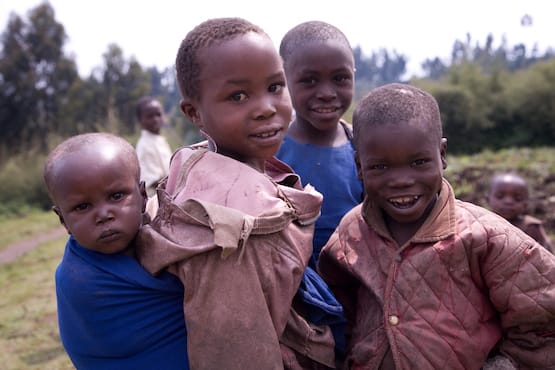
Malnutrition contributes to nearly half of all deaths in children under five.
Three kids in blue and red jackets. Take the pledge

Without proper nutrition, the poverty trap deepens: people become ill and vulnerable to disability or death, they cannot attend school or work, their families lose resources in order to care for them, and the cycle perpetuates.

The solution: cost-effective food fortification programs

Food fortification is one of the least expensive solutions to malnutrition, and has proven results. [5] Adding iron to soy sauce in China led to a 33% reduction in anaemia, and within a year of adding folic acid to wheat flour in Chile, spina bifida incidences were reduced by 51%. A 2015 baseline study by the Government of Tanzania in partnership with the Global Alliance for Improved Nutrition (GAIN) determined that only 2.5 per cent of the households consumed fortified flour. Soon after, Sanku launched operations in Tanzania, installing 70 Dosifier machines in small mills across the Morogoro region. A 2017 endline study by Helen Keller International (HKI) determined that fortified flour in households reached 72% in Tanzania’s Morogoro Municipal District.

How Sanku does it 

  1. Sanku installs its patented IoT enabled ‘smart’ Dosifier machines onto the small East African flour mills that feed millions of people. The fully automated Dosifier adds precise and safe amounts of critical nutrients into the key staple food people eat.
  2. Sanku produces the key inputs in-country that millers need to fortify, such as nutrient premix, flour bags and installs the Dosifier. Sanku owns the last mile of distribution throughout East Africa to ensure millers always have the key tools, training and support every day.
  3. Sanku monitors the millers’ use of our ‘smart’ Dosifier remotely via the machine’s cellular link and provides necessary support to the millers be it repairs or replacements of dosifiers and/or restocking of nutrients and flour bags. The Dosifier machines enable Sanku to quantitatively measure reach and impact via IoT.
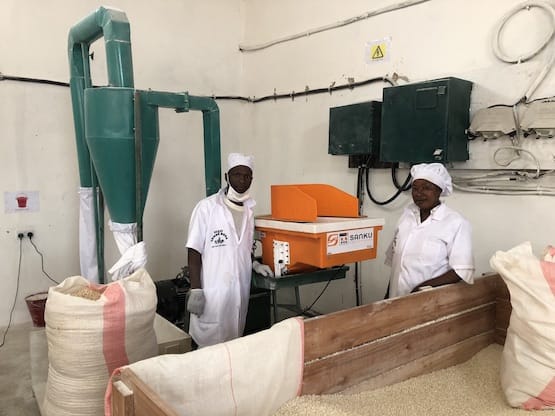
Two small-scale mill workers standing next to a Sanku dosifier
The Sanku dosifier is orange. Bags with pink stripes are sold to millers by PHC-Sanku.

Sanku bulk-buys empty flour bags, which are then sold to the millers at the same price they would otherwise pay. They use the profits to provide millers the appropriate amount of premix at no additional cost. The dosifier’s proprietary technology is fully automated. Sanku monitors the miller’s use of the dosifier remotely, and visits the mill if the dosifier is not in use or needs repair. Sanku is on track to reach more than 100 million people within the decade.

What makes Sanku - Project Healthy Children so effective


Cost-effectiveness

On average, Sanku’s program costs $0.38 to fortify food for one person annually. This number is expected to be reduced due to enhanced economies of scale.

Scalability

Sanku partners with various stakeholders including the Government, INGOs, millers and other partners to reach 10 million people with nutritious food every day. Sanku currently works with nearly 1200 mills to give millions of East Africans access to fortified food.

Compounding impact

Food fortification takes pressure off healthcare systems by preventing illness and disease. It also helps grow developing economies. Recent evidence from the Gates Foundation indicates that every US$1 invested in food fortification generates approximately US$27 in economic returns [6].


Sanku – Project Healthy Children’s accountability and sustainability

Sanku – PHC reports its metrics of success online, detailing how the organization measures impact, performance, process, and cost-effectiveness. [7] More importantly, Sanku – PHC’s overarching mission is to ensure that they do not become a permanent part of a country’s food distribution and health systems. They help launch successful initiatives and excel at finding sustainable ways for governments to continue that work without a permanent presence.


Recognition and awards:

In 2026, Sanku was named the Grand Prize Winner of the Seeding the Future Global Food System Challenge, recognizing its IoT-enabled fortification model, which now reaches more than 73 million people across Eastern Africa with access to nutritious fortified flour. In the same year TIME Magazine recognized Sanku as one of the 10 Most Influential Social Good Companies of 2026.

In 2025, Sanku’s documentary, Hidden Hunger, received the FAO Award for Best Focus Film on Women in Agrifood Systems at the World Food Forum in Rome. Produced by filmmaker Orit Novak, the film highlights the voices of women across the fortification ecosystem, including mothers, millers, farmers, and advocates. Sanku’s CEO, Felix Brooks-Church, served as Executive Producer.

In 2024, Sanku was selected as one of the top innovators in the Empowering Vulnerable Communities Challenge by UpLink – the World Economic Forum, organized in collaboration with the Forum’s Humanitarian and Resilience Investing Initiative and the IKEA Foundation.

In 2022, Sanku won Classy.org’s 2022 Social Innovation Award. The Classy Awards honour the most innovative non-profit organisations.

In 2021, Rolex selected Sanku’s CEO, Felix Brooks-church, as one of five Laureates of the prestigious Rolex Awards for Enterprise, for their visionary projects that have the potential to reinvent the future.

In 2020, Sanku was awarded The Lipman Family Grand Prize for effectively scaling our market-based solution to end hidden hunger.

In 2019, Sanku’s Dosifier was named to TIME Magazine’s 100 Best Inventions. The magazine’s annual list honors inventions that are making the world better, smarter and even a bit more fun. 

In 2019, Sanku was awarded the Zayed Sustainability Prize which recognizes and rewards the achievements of those who are driving impactful, innovative and inspiring sustainability solutions across five distinct categories: Health, Food, Energy, Water and Global High Schools.