 Australia site →
 Global tax-deductible giving →
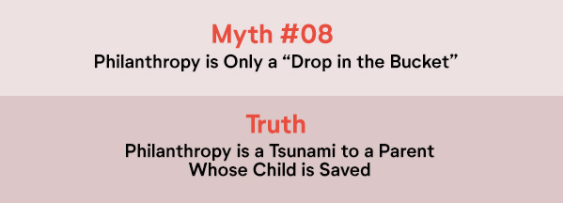
One of the common objections to donating to help the global poor is that the help is just a “drop in the bucket” Really? If your child was dying of diarrhea and needed IV fluids, what would you do? Here comes a rhetorical question. Would you say that help is just a “drop in the bucket” and is only worth obtaining if you could save all the children that die of diarrhea and solve the poor healthcare system?
In fact, ~500,000 children die of diarrhea each year — it is the 3rd leading cause of child mortality globally behind pneumonia and preterm birth complications. But Development Media International (DMI) creates radio and television ads that teach parents, usually moms, what to do when their child has diarrhea. By getting moms to understand their child’s illness and get the help they need, DMI saves lives for incredibly few dollars per child’s life saved. “It’s one of the simplest and most cost-effective wins in public health.” Hardly, a “drop in the bucket” for the parent whose child is saved.
Everyone on our team at The Life You Can Save would love to live in a world where philanthropy is not necessary. We imagine a world where there is no extreme poverty, where everyone has access to healthy food, adequate housing, good health care, safe water, and sanitation facilities. That world is possible, but obviously does not yet exist.
But what does exist are amazingly impactful, cost-effective nonprofits that save lives, reduce unnecessary suffering and empower livelihoods. Our recommended nonprofits create “tsunami’s” of life-saving help for millions of families and are part of the drive to reduce extreme poverty from the current ~ 9% of the world’s population, (~700 million people), to 3% by 2030. COVID-19 is making achieving this goal more difficult, which means support for these highly impactful, cost-effective nonprofits is more important than ever.
Their work is clearly not a drop in the bucket!
Do Good. Feel Good.
Charlie