
At The Life You Can Save, every recommendation we make begins with a question: How can we ensure a donation does the most good possible? Or, to put it more concretely: how can we ensure not just that every donation helps the people with the greatest need overcome the most serious threats caused by extreme poverty, but that it funds interventions cost-effective and impactful enough to help not just thousands, but millions, escape extreme poverty?
We’ve dedicated years to answering this question in a way that’s evidence-based, transparent, and confidence-inspiring. Our 2025 evaluation framework presents the most detailed and systematic account of how we evaluate our recommended charities to date. This blogpost highlights several updates and refinements we’ve made to ensure every donation makes a measurable impact.
Problem, Intervention, and Organization
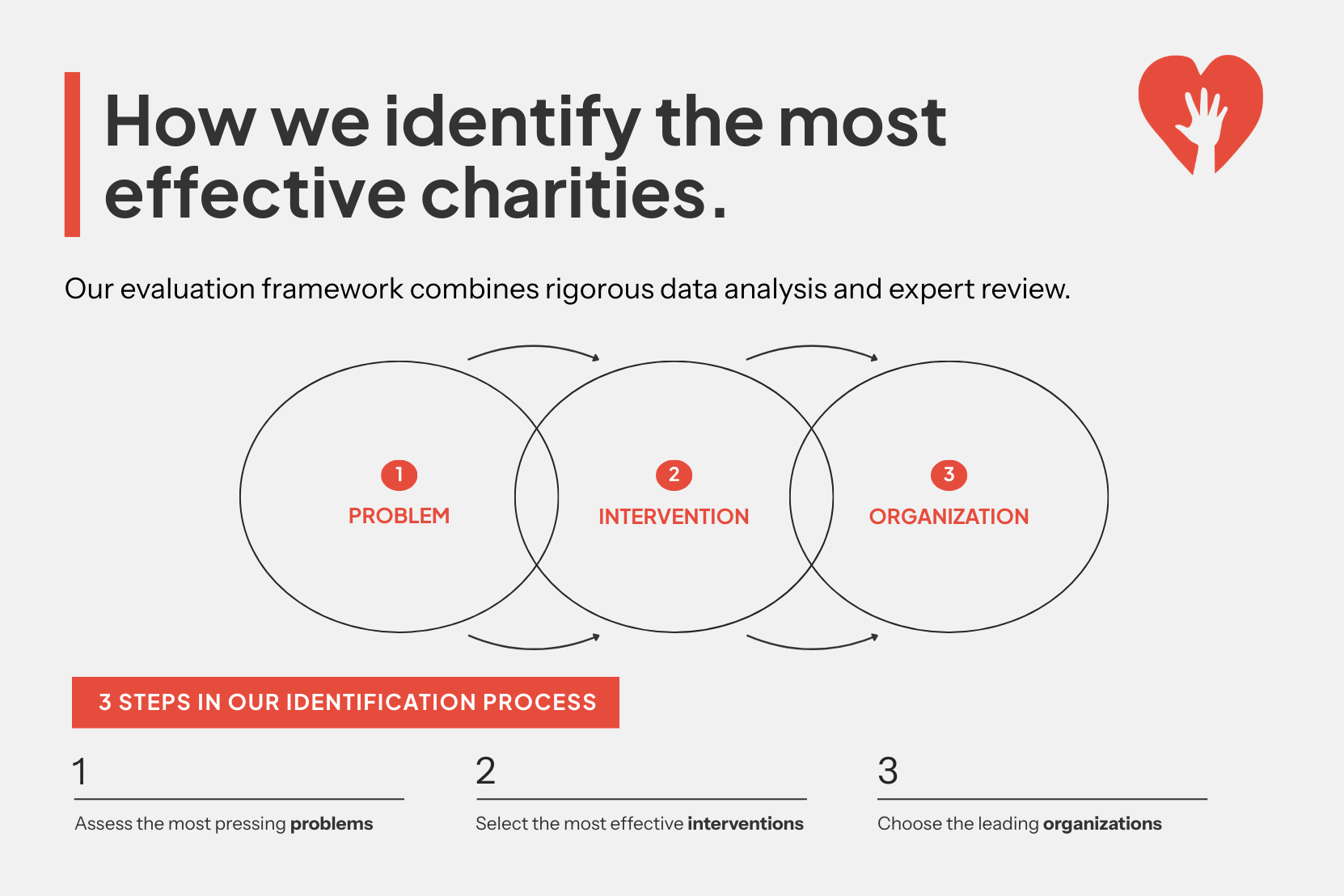
Our 2025 framework introduces a three sphere model that breaks our evaluation process down into three key aspects: problem, intervention, and organization. First, we identify the most pressing problems caused by extreme poverty. Then we identify the most effective interventions to address these problems. And, finally, we identify and recommend high quality organizations capable of successfully implementing these interventions at scale.
We evaluate every recommendation across these three dimensions using a total of sixteen criteria. We analyze each dimension using a unique set of criteria designed to highlight key factors, clearly articulate our priorities, and structure our evaluation.
When we evaluate a specific problem that a nonprofit aims to address, for instance, we use three criteria—scale, solvability, and additionality—that, respectively, help us prioritize problems that severely impact the vast majority of people living in extreme poverty in our priority geographies (scale), problems that can in principle be solved by existing interventions (solvability), and problems that are neglected enough to benefit substantially from additional support (additionality).
Weighing What Matters Most
We assign some criteria greater weight to reflect our top priorities. When evaluating an intervention, for instance, we give special weight to demonstrated evidence of impact and cost effectiveness. But we also evaluate whether interventions are easily scalable (scale), whether they positively impact multiple dimensions of poverty at once (depth), and whether they have a lasting impact (durable). Although weighted less, these three criteria of scale, depth, and durability help reinforce our top priorities. If an intervention is easily scalable, for instance, it is also highly likely to be cost-effective.
Why Organizations Matter as Much as Interventions
Because interventions must ultimately be implemented by nonprofit organizations, there is considerable overlap between the criteria we use to evaluate interventions and those we use to evaluate organizations. Like interventions, organizations are also evaluated based on evidence of impact, cost-effectiveness, capacity to operate at scale, depth and durability.
This additional organization-level assessment is important because, even if an intervention is proven to be impactful and cost-effective in general, this does not guarantee that it will be impactful in a specific context. Highly effective interventions still require organizations with the capacity to implement them broadly and reliably.
These critical distinctions demonstrate the value of using a three sphere model that approaches the evaluations of interventions and organizations separately, despite their overlap. They also motivate the additional criteria we use to assess an organization’s overall quality, its embeddedness in local systems, its funding sources, and other factors that help ensure that an intervention takes hold in a specific context.
Among these factors, our evaluation framework places special emphasis on an organization’s respect for the dignity of its beneficiaries. We believe that any charity considered impactful must also be one that respects the dignity, priorities, and agency of those it serves. Our partnership with IDInsight’s Dignity Initiative has produced a robust set of criteria that ensure the organizations we recommend treat beneficiaries as equal partners.
Adopting Best Practices from Healthcare and Education
In addition to introducing a three sphere model, our 2025 evaluation framework strengthens several of our existing criteria by adopting—and, where necessary, adapting—metrics and frameworks developed by leading researchers in the fields of healthcare and education.
To assess quality of evidence for interventions, we now use an adapted version of the Grading of Recommendations, Assessment, Development and Evaluation (GRADE) structure framework developed in the healthcare field. To assess scalability of interventions, we have incorporated a typology developed by Harvard Kennedy School to assess scalability of interventions. And to assess the impactfulness of interventions in education, we have adopted the Learning-Adjusted Years of Schooling (LAYS) standard developed by the World Bank to mirror the Disability-Adjusted Life Years (DALY) metric widely used to measure the impact of interventions in health and also featured in our framework.
The Multidimensional Poverty Index
In 2023, we adopted the Multidimensional Poverty Index (MPI) to inform our understanding of poverty, and our 2025 evaluation framework continues to draw extensively from the MPI as both a key methodological tool and source of robust data about global poverty.
Among its many virtues, the MPI’s focus on how poverty deprives people of capacities and freedoms necessary to human dignity aligns with our special emphasis on recognizing and respecting the dignity of beneficiaries. Developed by Oxford Poverty and Human Development Initiative (OPHDI) and the United Nations Development Programme (UNDP), the MPI uses ten quality of life indicators across three dimensions — health, education, and standard of living — to measure the intensity of poverty individuals experience. According to the MPI, people living in extreme poverty experience deprivations in over a third of these ten indicators (with some critical indicators—like child mortality and nutrition—weighed higher than others).
Our 2025 evaluation framework uses the three MPI dimensions of health, education, and standards of living to assess the impact and cost effectiveness of an intervention. Aligning our cause areas with the MPI enables us to use MPI indicators in our evaluation criteria. For instance, we use MPI indicators to evaluate a problem’s scale and intervention’s depth. The more MPI indicators a problem impacts, the larger and more intense its scale. By the same token, the more MPI indicators an intervention impacts, the greater its depth.
In this way, MPI indicators encourage us to prioritize addressing the most severe “drivers” of extreme poverty like malaria and diarrheal diseases for child mortality, school costs and gender norms for education, and lack of access to markets or lack of capital for standard of living. They also encourage us to prioritize deep interventions that respond to and address the multidimensional nature of poverty.
The annual MPI report provides some of the most comprehensive, real-time data on global poverty available, and we use this extensive data to determine what regions we should prioritize. The most recent MPI report presents data from 109 countries, including 1,359 subregions across 101 countries. We focus on supporting nonprofits operating in Sub-Saharan Africa and South Asia because the MPI indicates that these two regions have the greatest concentration of multidimensional poverty—and the greatest opportunity for impact.
The most recent MPI report estimates that 1.1 billion or 6.3 billion people—or roughly 1 in 5—live in acute multidimensional poverty, including 550 million children. Many—if not most—live in our two priority geographies. And millions have and continue to benefit from impactful interventions made possible by your generous support and the relentless, impactful work of our recommended charities.
A Framework That Delivers on Our Promise
Even though our 2025 framework simply refines systems we’ve had in place for years, we’re proud of rigor, transparency, and moral clarity it introduces to our process, all insight gained from years of research, trial and error, and continuous improvement. We believe our 2025 framework shows how evidence, transparency, and respect for human dignity can come together to guide better giving. And the systematic and replicable processes our 2025 framework introduces make us more confident than ever that our recommendations and your support really do the most good possible.