Building Tomorrow is an international nonprofit organization dedicated to improving access to quality, inclusive education for children in rural Uganda and Rwanda. Its primary beneficiaries are un- and under-schooled learners who lack foundational competencies in basic literacy and numeracy. The organization strives to boost school enrollment and learning outcomes by training teachers and Community Education Volunteers who deliver targeted instruction in schools and community-based camps using evidence-based pedagogy.
Their demonstrated impact includes:
Reached 401,966 learners through the signature Roots to Rise (R2R) literacy and numeracy program in 2025 alone.
Improved literacy proficiency, enabling 76.8% of R2R learners to reach the minimum proficiency level for their class at endline, compared to just 12.7% at baseline.
Significantly boosted numeracy outcomes, with 74.4% of R2R learners achieving the minimum proficiency level at endline, compared to 14.6% at baseline.
Achieved volunteer recruitment at scale, onboarding over 1,800 local Community Education Volunteers (CEVs) through government-partnered efforts across initial pilot districts.
: Foundational Literacy, Foundational Numeracy, (Re-) Enrollment of Out-of-School Children, and Progressive Advancement Across Learning Levels
Recent Expense Budget
: $7.37 Million (FY 2026)
Year Founded
: 2006
The Problem: Widespread Learning Poverty in Sub-Saharan Africa
Learning poverty refers to a severe global crisis resulting in children unable to read and understand a simple text by the age of 10. In Sub-Saharan Africa, this challenge affects a staggering 90% of children, encompassing both the 20% who are completely out of school and the 70% who attend school regularly but fail to acquire foundational skills. In Uganda, approximately 82% of late primary-age children are not proficient in reading.
Contributing factors include overly ambitious school curricula that do not match students’ actual learning capacities, alongside primary teachers who face isolation, limited specialized training, and a lack of structured instructional support.
The failure to establish these foundational core competencies early creates severe long-term consequences; children who fall behind are much more likely to repeat grades, drop out entirely, remain trapped in poverty, and face restricted life opportunities. This educational crisis disproportionately impacts children from rural, low-income, and marginalized backgrounds, entrenching a systemic failure where education systems deliver formal schooling but not actual learning.
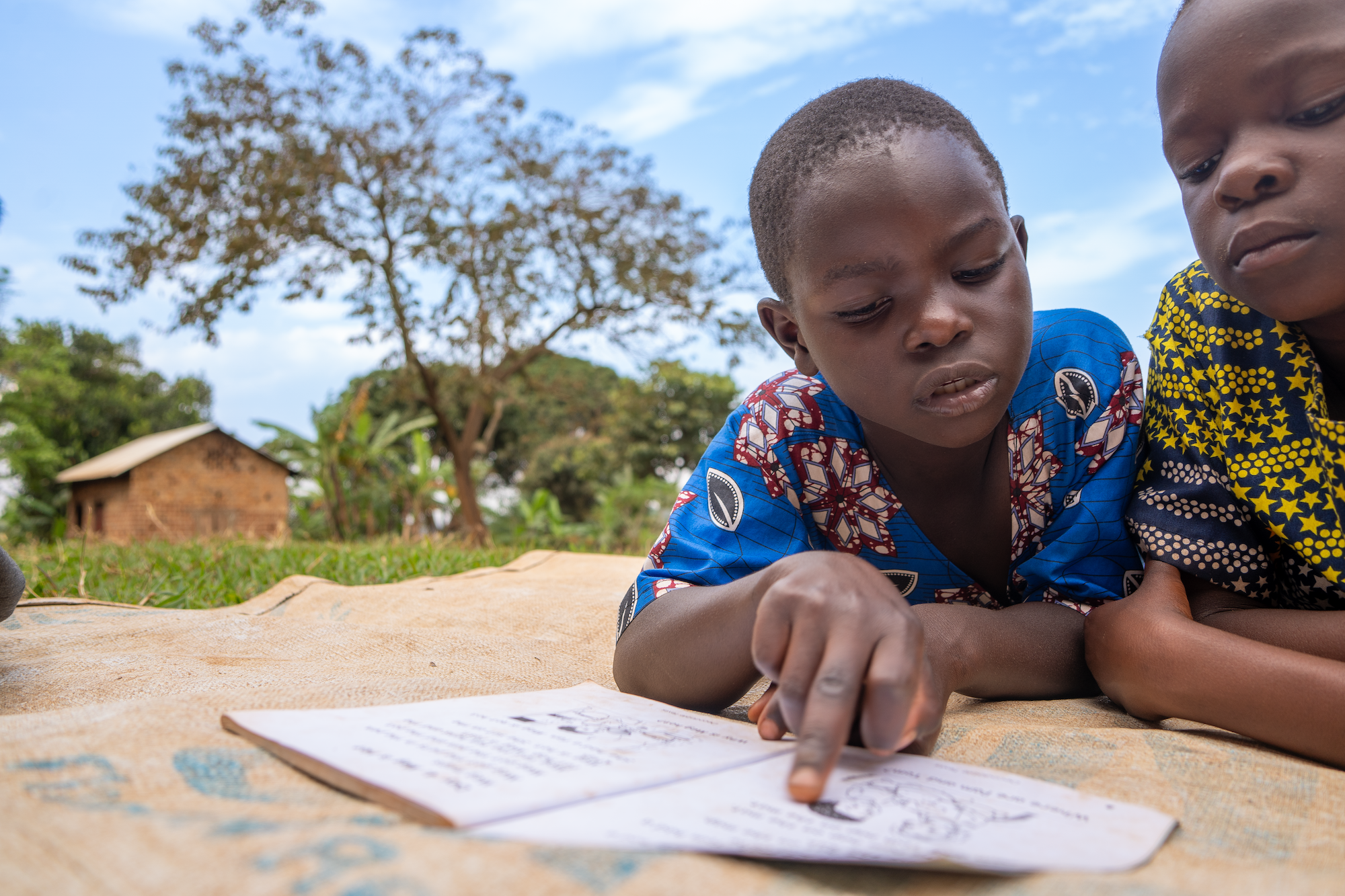
9-year-old Jenifer reads a Roots to Rise story booklet with a friend during a Roots to Rise community camp in Mityana District, Uganda.
The Solution: Community-based, Level-appropriate Learning
Building Tomorrow combats this crisis through its signature Roots to Rise (R2R) literacy and numeracy program. Grounded in the evidence-based Teaching at the Right Level (TaRL) pedagogy, R2R discards rigid age- and grade-based tracking to tailor instruction directly to a child’s actual learning level.
The organization operates under an intentional model of community-based learning, partnering strategically with local and central governments to scale its intervention. By deploying university-graduate Fellows to recruit and upskill local volunteers, Building Tomorrow establishes a sustainable and locally contextualized model that guarantees measurable learning gains while transitioning long-term execution directly into national education systems for sustainability.
Building Tomorrow tackles the issue at its roots by focusing on the following key activities:
Implementing level-appropriate remedial curricula to systematically improve foundational math and reading competencies.
Mobilizing university-graduate Fellows to act as proximate leaders who build local community capacity and serve as operational links with district authorities.
Enlisting and training local Community Education Volunteers (CEVs) to facilitate direct, trusted, and localized instruction.
Training and upskilling teachers on Building Tomorrow’s evidence-based pedagogies, offering continued mentoring support to improve teacher practice.
Running flexible in-school sessions and community-based learning camps that protect educational continuity against system shocks, teacher strikes, or political shifts.
Embedding robust child safeguarding and inclusive education practices across all local operations to protect children and preserve beneficiary dignity.
Community Education Volunteer Agnes leads a Roots to Rise literacy camp in Ngogorero District, Rwanda.
How Building Tomorrow works
Fellows Deployment and Systems Bridging: Building Tomorrow recruits and deploys university-graduate Fellows into underserved rural areas. These Fellows act as operational catalysts who organize local Community Education Teams, coordinate field volunteers, and report granular, real-time data back to district officials to amplify local educational challenges and opportunities.
Recruitment and Local Vetting of Volunteers: Fellows collaborate closely with village leadership, such as Local Council chairpersons, to identify, vet, and approve resident Community Education Volunteers (CEVs). Because CEVs are trusted, permanent members of the communities where they operate, they provide an invaluable layer of safety, comfort, and accountability for local families.
Roots to Rise (R2R) Instruction: The core intervention groups children into smaller, collaborative cohorts based entirely on their assessed learning levels. Facilitators use highly interactive, child-friendly, and learner-centered methods to focus intensely on building foundational micro-competencies in reading and math.
School and Community Camp Classrooms: Instruction is delivered both within regular primary schools by trained teachers and through community-based camps by trained CEVs. These community camps serve as an adaptive and highly resilient alternative to formal schooling, shielding children from learning loss during institutional disruptions. All camp and household activities are conducted with the formal, active consent of parents or caretakers.
Formative Baseline & Endline Evaluation: Before instructional delivery begins, a pre-test formative assessment is administered to map each student’s starting learning level. At the close of the learning cycle, a post-test evaluation measures individual advancement and verifies how many students have successfully attained the Minimum Proficiency Level (MPL)—meaning they no longer require remediation and are equipped to thrive at their class level.
Government Integration for Systemic Scale: Viewing the state as the ultimate vehicle for scale, Building Tomorrow collaborates with institutions like Uganda’s Ministry of Education and Sports to integrate R2R nationwide. They second experienced Fellows alumni directly into district offices as Education Systems Strengthening Coordinators (ESSCs) to build administrative capacity.
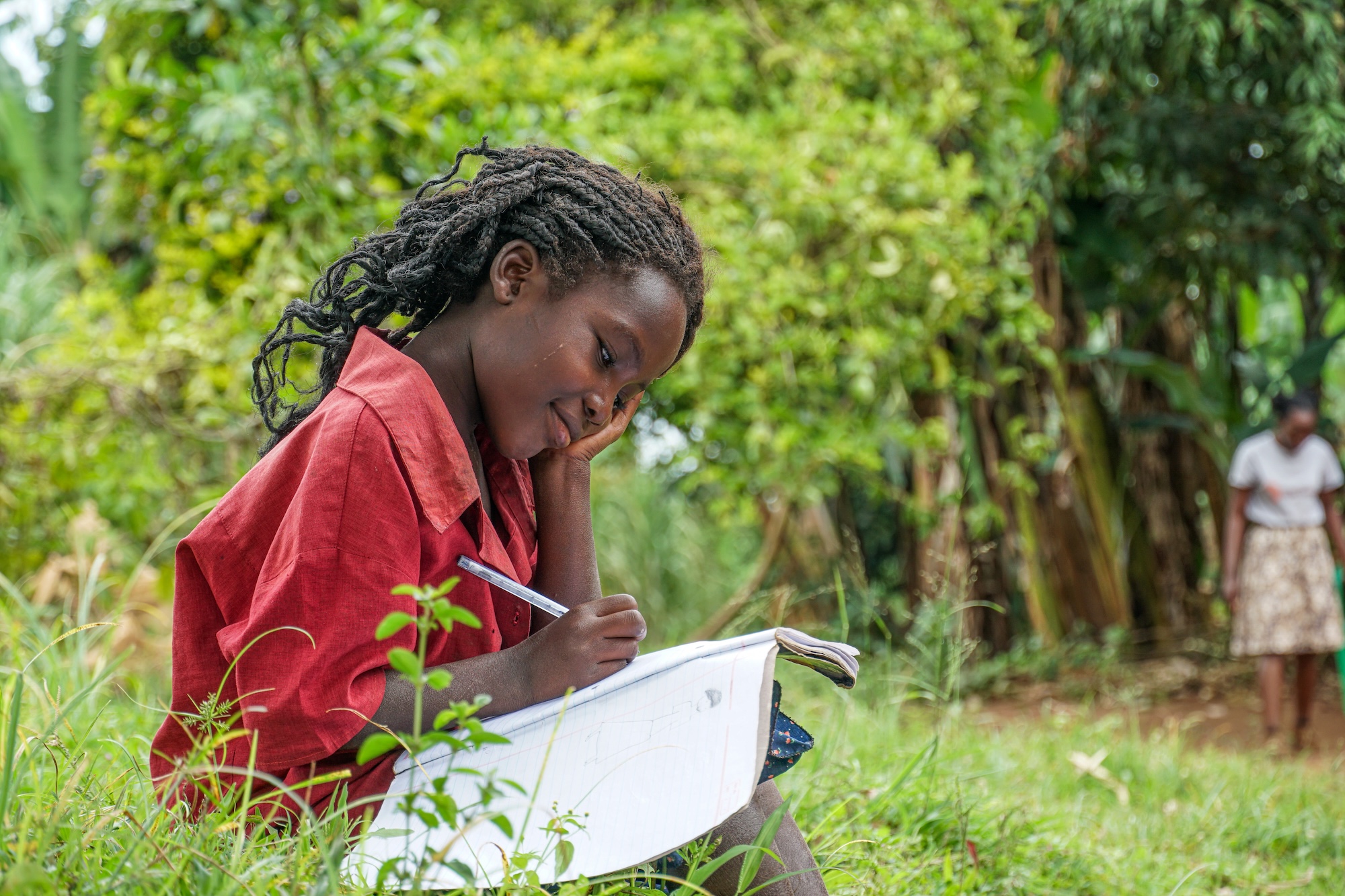
Nango, a learner in Luuka District, Uganda, writes new words during a Roots to Rise literacy camp.
401,966
Learners reached with foundational programming in 2025.
9 LAYS
Learning-Adjusted Years of Schooling generated per $100 spent.
+25,400
Community Education Volunteers recruited since starting operations.
Other ways to donate
We recommend that gifts up to $1,000 be made online by credit card. If you are giving more than $1,000, please consider one of these alternatives.
What can you help Building Tomorrow achieve? Enter a donation amount below to find out.
USD
What makes Building Tomorrow so effective
Proven results
Building Tomorrow has scaled significantly since its founding in 2006, expanding its footprint across 47 Ugandan districts to date and successfully launching operations in Rwanda. Over its years of operation, its core ground network of university-graduate Fellows has grown from 10 leaders in 2015 to 250 in 2025. This rapid expansion allowed the organization to reach 401,966 annual Roots to Rise (R2R) learners in 2025 alone, cementing its position as the largest implementer of Teaching at the Right Level (TaRL)-based learning in Uganda.
Building Tomorrow’s model is backed by a robust evidence base, including two externally conducted randomized controlled trials (RCTs) that validate its real-world effectiveness. In 2021–2022, Building Tomorrow participated in a rigorous five-country RCT with Youth Impact to evaluate low-tech interventions in stemming learning loss. The results offered compelling proof of concept: less than three hours of 1:1 targeted tutoring delivered by Community Education Volunteers (CEVs) over the phone across an eight-week period yielded massive learning gains equivalent to 0.891 standard deviations and 1.1 Learning-Adjusted Years of Schooling (LAYS).
Furthermore, a 2023 RCT led by a research team from the University of Notre Dame evaluated the full package of Building Tomorrow’s programming—including the combined deployment of Fellows and CEVs—against a control group. This trial proved that learners in Building Tomorrow-supported schools made 41% more progress in mathematics, were 30% less likely to fall behind, and received 79% more direct instructional time. Additionally, a 2024 difference-in-differences analysis supported by Youth Impact demonstrated that students learned 20x more with 40 hours of R2R instruction than they did during a typical school term, advancing more than a full learning level above standard schooling.
Community ownership
Building Tomorrow’s programmatic intervention hinges on a dedicated cadre of local change agents—composed of resident Community Education Volunteers (CEVs) and university-graduate Fellows—who actively champion foundational learning across rural villages. Upon deployment, Fellows undergo an intensive community immersion period to deeply understand their assigned schools and neighborhoods. They work directly with Local Council 1 chairpersons to recruit, vet, and train resident CEVs, as well as identify two focal teachers per school for training and mentorship.
The program facilitates genuine community ownership through these CEVs, who are permanent, highly trusted members of the exact communities where they operate. Because they live in the same villages, they understand local needs and priorities intimately, making them uniquely positioned to collaborate with families, overcome localized mindset barriers, and lead flexible community-based learning camps. By arming CEVs with simple, replicable, and behavior-change-ready tools, Building Tomorrow builds permanent local capacity. This ground-up infrastructure unites parents, volunteers, and school leadership into cohesive Community Education Teams, establishing sustainable communities of practice that collectively mobilize around the importance of quality education and inclusion.
Data for impact
Using impact data as a strategic anchor for constant improvement, Building Tomorrow maintains a deep organizational commitment to data-driven operational enhancement. The organization sets rigorous annual Key Performance Indicators (KPIs) based on historical trend analysis to systematically optimize student learning gains across its operating sites.
To maintain total operational transparency and coordinate effectively at scale, Building Tomorrow hosts public monthly program dashboards directly on its website. This data-driven framework allows the organization to precisely amplify local educational challenges, rapidly mitigate system shocks (such as health outbreaks or teacher strikes), and deploy instructional resources straight to the specific schools and households that most require foundational learning remediation.
Building Tomorrow’s accountability and sustainability
While targeting critical educational outcomes like student re-enrollment, retention, and foundational learning, Building Tomorrow’s intervention focuses on mindset and behavior change in conjunction with systemic change. This dual approach delivers significantly higher efficacy and long-term sustainability than isolated, single-strategy solutions. From the very outset, Building Tomorrow works with local communities and the formal government apparatus to ensure that the learning gains achieved during its presence are fully sustained long after active clusters phase out.
CEVs introduce simple, replicable pedagogical tools that demystify the learning process, empowering families to take permanent, active ownership of their children’s education. This persistent and visible volunteer presence drives a profound mindset shift across rural villages, embedding an environment where communities proactively prioritize foundational literacy and numeracy year after year. The core logic is clear: reinforce the message of early learning and inclusion across all local stakeholders, and witness community-led accountability transform into sustained educational success.
Furthermore, Building Tomorrow treats the state as the ultimate vehicle for scale and systemic sustainability. At the district level, the organization actively pilots sustainability structures to smoothly transition the coordination of volunteer networks entirely over to local governments. This is achieved by seconding senior Fellows alumni directly into district government offices as Education Systems Strengthening Coordinators (ESSCs) for three-year tenures to systematically build administrative capacity.
At the national level, Building Tomorrow secures institutional sustainability through formal agreements with national entities like Uganda’s Ministry of Education and Sports, which formally recognized its operating areas as “centers of excellence” modeling best practices for national replication. By actively partnering with national teacher education departments and core primary teacher training colleges, Building Tomorrow is working to embed its level-appropriate pedagogy straight into the country’s institutional teacher preparation curriculum, ensuring a lasting impact on the wider educational ecosystem.
Recognition for Building Tomorrow
Building Tomorrow was recognized as the US Library of Congress Literacy Awards International Prize recipient in 2025. This honor goes to one organization per year, awarded for outstanding international literacy promotion activities.
Building Tomorrow & Youth Impact. (2022, February).Less than three hours of remedial tutoring by community education volunteers delivers over one year of high-quality schooling: Youth Impact RCT overview one-pager.

 Australia site →
 Global tax-deductible giving →